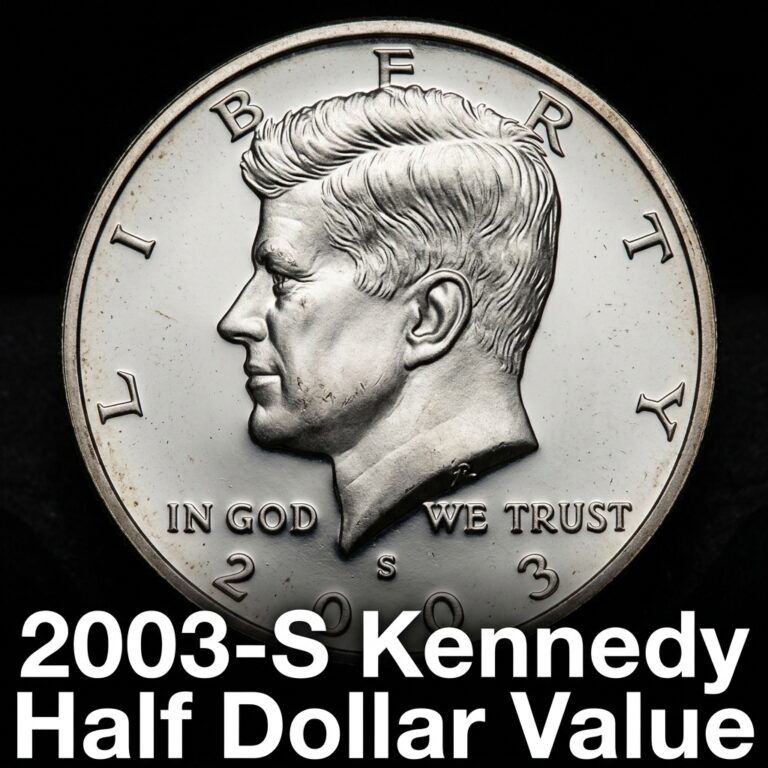
1989-S Roosevelt Dime Value: Collector Prices and Guide

Your Old Coin Could Be Valuable!
Identify It & Know Its Real Value — Free Download


The 1989-S Roosevelt Dime is worth anywhere from $3 in typical proof condition to over $500 for perfect specimens with rare features. While you won’t find this specific coin in your pocket change, it is a staple of modern American coin collecting that often surfaces in inherited collections or estate sales.
| Condition / Grade | Estimated Value |
|---|---|
| PR 67 Deep Cameo | $3 – $5 |
| PR 69 Deep Cameo | $12 – $18 |
| PR 70 Deep Cameo (Perfect) | $45 – $110 |
| Rare Error Varieties | $100+ |
Identifying the 1989-S Roosevelt Dime Proof Coin
The 1989-S Roosevelt Dime is unique because it was never intended for circulation. Unlike the dimes minted in Philadelphia or Denver, which have “P” or “D” mint marks and are handled by millions of people daily, the “S” mint mark signifies that this coin was produced at the San Francisco Mint specifically for collectors. These are known as “Proof” coins. They are struck multiple times using polished dies and specially prepared planchets (the metal discs), resulting in a mirror-like finish.
If you have found a 1989 dime and it looks exceptionally shiny—almost like a mirror—you should check the right side of the coin, just above the year. If you see a small “S,” you have a proof dime. Because these were sold in protective sets, they usually remain in excellent condition. To help you identify if your coin is a rare variety or a standard strike, using a top coin identifier and value app can save you hours of research.
Collectors highly prize “Deep Cameo” (DCAM) finishes on these coins. This occurs when the portrait of FDR and the torch on the reverse appear frosty and white, creating a sharp contrast against the dark, reflective background. Most 1989-S dimes found today will have this finish, as the San Francisco Mint had perfected the technique by the late 1980s. When using CoinKnow, many users discover that their inherited sets are actually valuable Deep Cameo specimens.
Your Old Coin Could Be Valuable!
Identify It & Know Its Real Value — Free Download
The Market Value of 1989-S Dimes by Grade
When determining the value of your 1989 San Francisco Mint dime, the “grade” is the most important factor. Since these are proof coins, the grading scale ranges from PR 60 to PR 70. A PR 70 coin is considered “Museum Quality” with no visible flaws even under 5x magnification. For most casual collectors, your coin will likely fall into the PR 67 to PR 69 range.
Even though billions of dimes were made in 1989 across all mints, only 3,220,194 of the 1989-S proof dimes were struck. This makes them significantly rarer than their “P” and “D” counterparts. You can check the current market price data for 1989 dimes to see how the proof versions compare to the standard business strikes that people usually find in their wallets.
Your Old Coin Could Be Valuable!
Identify It & Know Its Real Value — Free Download
The price gap between a PR 69 and a PR 70 is substantial. While a 69 might sell for the price of a fancy cup of coffee, a perfect 70 can fetch a premium from registry set collectors who want nothing but the best. If you aren’t sure how to grade your coin, the CoinKnow app can help you analyze the surface details to estimate where it falls on the scale.
| Mintage Stats | Total Quantity struck |
|---|---|
| 1989-P (Philadelphia) | 1,298,380,000 |
| 1989-D (Denver) | 876,122,176 |
| 1989-S (San Francisco Proof) | 3,220,194 |
Design Characteristics and “Detailed Minting”
The Roosevelt Dime features the profile of President Franklin D. Roosevelt on the obverse. This design has remained largely unchanged since its debut in 1946. On the reverse, you will find an olive branch, a torch, and an oak branch, symbolizing peace, liberty, and victory. On the 1989-S proof coin, these details are exceptionally crisp.
One thing collectors look for is “Full Torch” (FT) or “Full Bands” details. While this designation is more common for business strikes (P and D mints) found in high grades, it refers to the horizontal bands on the torch being clearly separated. For more information on why these details matter, you can explore this detailed guide on 1989 dime values.
Your Old Coin Could Be Valuable!
Identify It & Know Its Real Value — Free Download
Because the 1989-S are proofs, they almost always show full details. If you notice any “bleeding” of the design or mushy details, you might actually be looking at a very high-quality business strike that someone mistook for a proof, or perhaps a rare error. Modern coin apps like CoinKnow allow you to take high-resolution photos to check these small details against a database of known examples.
Are There Any Rare 1989-S Dime Varieties?
Generally, the 1989-S is a very consistent issue. Unlike the famous 1990 “No S” proof dime which is worth thousands, no such major catastrophe occurred in 1989. However, error collectors still hunt for “Doubled Die” varieties or “Re-punched Mint Marks.” A doubled die would show clear doubling on the letters of “LIBERTY” or the date.
Another potential area of value is the “Frosted” vs. “Satin” appearance. By 1989, the San Francisco Mint was very good at producing the Deep Cameo effect. If you find a 1989-S that lacks this contrast—meaning the background is shiny but the portrait is NOT frosty—it might be an early strike or a die variety that attracts niche interest.
Your Old Coin Could Be Valuable!
Identify It & Know Its Real Value — Free Download
If you suspect you have an error coin, don’t clean it! Cleaning a coin with chemicals or clothes will instantly destroy its numismatic value. A proof coin’s value is derived from its pristine, untouched surface. If it has fingerprints or scratches (known as “hairlines”), the value drops significantly toward its face value or the price of a common donor coin.
| Error Type | Visual Indicator | Potential Value |
|---|---|---|
| Doubled Die Obverse | Blurred or double letters in LIBERTY | $20 – $50 |
| Off-Center Strike | Design not centered on the coin | $50 – $200 |
| Die Break (Cud) | Raised lump of metal on the edge | $15 – $40 |
Where to Sell and Buy Your 1989-S Roosevelt Dime
If you discover a perfect 1989-S dime and decide you want to sell it, you have several options. For common proof coins that are not professionally graded by PCGS or NGC, selling on platforms like eBay is the most common route. These coins are often sold as part of the “1989 Proof Set,” which includes the penny, nickel, quarter, and half dollar.
Local coin shops are another great resource, though they may not pay top dollar for a single proof dime unless it is a perfect Grade 70. They have to account for their own resale margin. If you have a large collection, it is worth using a tool to inventory everything first. Seeing the realized prices in an app can give you the confidence to negotiate with dealers.
For those looking to buy, 1989-S dimes are very affordable. They are a great way to introduce children to coin collecting because they are beautiful, historic, and don’t cost a fortune. You can often find them in local “bid boards” or coin shows for just a few dollars.
Your Old Coin Could Be Valuable!
Identify It & Know Its Real Value — Free Download
How Construction and Composition Influence 1989 Dime Value
It is important to remember that the 1989-S Roosevelt Dime is not made of silver. Millions of people assume that any “shiny” old dime must be silver, but the U.S. Mint stopped using 90% silver for Roosevelt dimes in 1964. The 1989 issue is a “clad” coin, meaning it has an inner core of pure copper and an outer layer of 75% copper and 25% nickel.
Because it lacks precious metal content, its value is purely “numismatic”—based on rarity and condition rather than the “melt value.” This is why the condition is so critical. A scratched 1989-S dime is technically only worth ten cents as legal tender, though most collectors would still pay a small premium for the “S” mint mark.
If you are looking for silver, the U.S. Mint did not start producing Silver Proof Sets again until 1992. Therefore, every 1989-S dime you find will be the standard cupro-nickel clad version. Despite the lack of silver, many of these coins have been preserved in private collections for decades, waiting to be rediscovered by a new generation of enthusiasts.
FAQ
Q: Is a 1989-S dime made of silver?
A: No, the 1989-S Roosevelt Dime is a clad coin made of copper and nickel. Silver proof dimes were not produced by the U.S. Mint in 1989; they resumed in 1992.
Your Old Coin Could Be Valuable!
Identify It & Know Its Real Value — Free Download
Q: How can I tell if my 1989 dime is a proof?
A: Look for the “S” mint mark to the right of Roosevelt’s neck. Additionally, proof coins have a mirror-like, reflective background and very sharp details compared to the “flat” look of coins found in pocket change.
Q: What is the most expensive 1989 dime ever sold?
A: While standard 1989-S dimes sell for a few dollars, perfect PR70 Deep Cameo examples have sold at auction for over $500. Error coins, like those struck on the wrong metal planchet (if they exist), would be worth significantly more.
Q: Should I get my 1989-S dime professionally graded?
A: Only if it looks absolutely flawless. Since the cost of grading (shipping + fees) is usually around $30-$50, the coin needs to be a guaranteed PR 70 to make a profit. Most PR 69 coins are worth less than the cost of the grading service itself.