
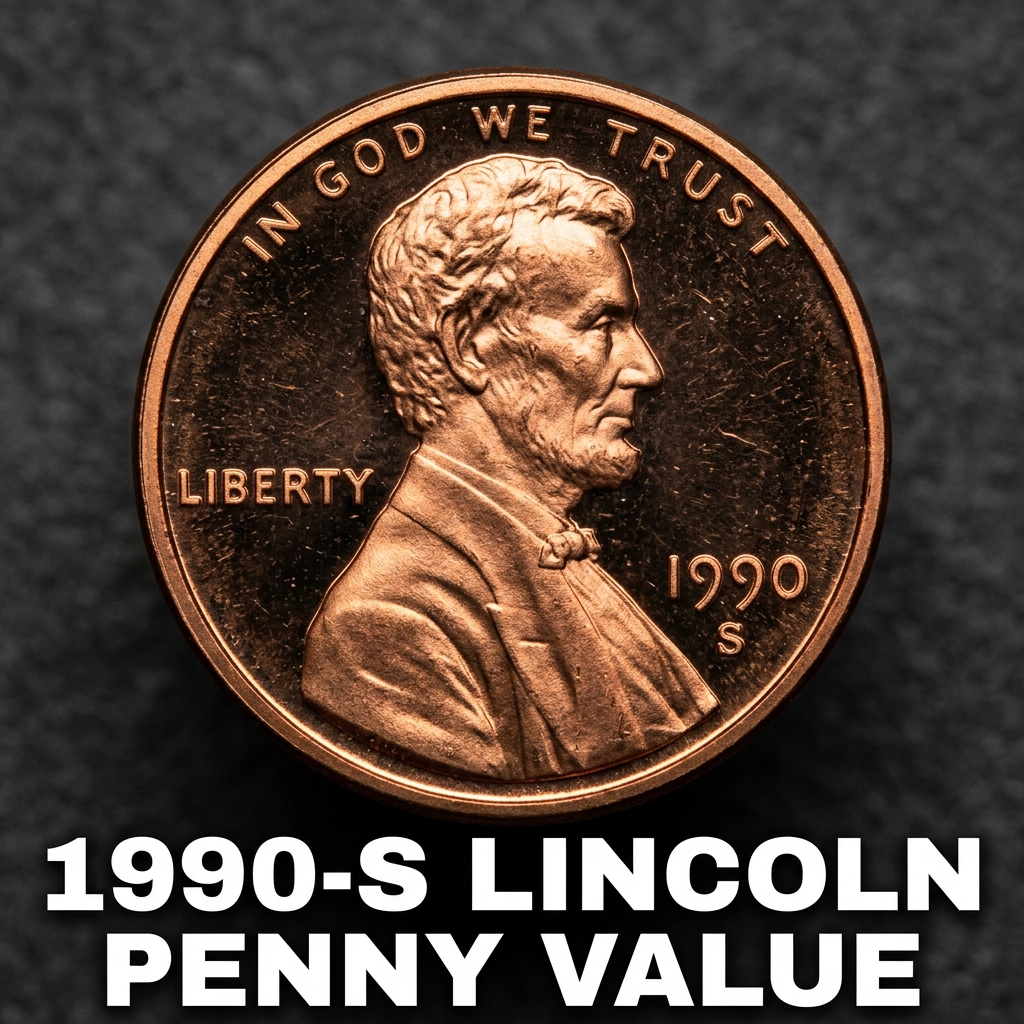
1990-S Lincoln Penny Value Guide What Your Proof Coin Is Actually Worth

Your Old Coin Could Be Valuable!
Identify It & Know Its Real Value — Free Download


The 1990-S Lincoln Penny is worth anywhere from $3 in typical proof condition to over $7,000 for rare error coins, making it one of the more fascinating modern cents to research. Whether you just found one in an old collection or inherited a proof set, this guide will walk you through everything you need to know in plain, everyday language.
If you want a quick and easy way to identify your coin and get an instant value estimate, try using a coin identifier and value app right from your smartphone — it takes just a few seconds and can save you a lot of guesswork.
What Is the 1990-S Lincoln Penny?
The 1990-S Lincoln Penny was struck at the San Francisco Mint and was never intended for everyday circulation. It was produced exclusively as part of proof sets sold directly to collectors by the U.S. Mint. That “S” mintmark on the coin is what sets it apart from the regular Lincoln cents made in Philadelphia and Denver that year.
Proof coins go through a special striking process — highly polished dies press specially prepared blanks twice to create sharp, mirror-like surfaces. The result is a coin with incredible detail and a brilliant finish. Because of this process, proof coins are generally handled with care and stored in protective cases.
Your Old Coin Could Be Valuable!
Identify It & Know Its Real Value — Free Download
Most 1990-S Lincoln Pennies you’ll come across were sold as part of an official proof set and have never been touched with bare hands. That’s great news for their condition — and their value.
Your Old Coin Could Be Valuable!
Identify It & Know Its Real Value — Free Download
1990-S Lincoln Penny Value by Grade
For most 1990-S Lincoln Pennies, the value is modest but consistent. Since these were made specifically for collectors, almost all of them survived in excellent condition. A typical 1990-S proof penny grades around PR-65 to PR-69 on the professional grading scale, and values reflect that.
Here’s a simple breakdown of what your 1990-S Lincoln Penny might be worth based on its grade:
Your Old Coin Could Be Valuable!
Identify It & Know Its Real Value — Free Download
| Grade | Description | Estimated Value |
|---|---|---|
| PR-65 RD | Gem Proof, full red | $3 – $5 |
| PR-67 RD | Superb Proof, full red | $5 – $10 |
| PR-69 RD | Near-perfect Proof | $15 – $30 |
| PR-70 RD (DCAM) | Perfect Proof, Deep Cameo | $50 – $150+ |
| No-S Error (any grade) | Missing mintmark error | $3,000 – $7,500+ |
You can explore detailed 1990-S Lincoln Penny price data by grade and condition to see how recent auction results compare to these estimates.
The Rare 1990 No-S Proof Penny Error
Here’s where things get really exciting. In 1990, a small number of proof pennies were accidentally struck without the “S” mintmark. These are known as the 1990 No-S Lincoln Proof Penny — and they’re one of the most sought-after modern U.S. coin errors in existence.
Only about 200 examples are believed to exist. When one shows up at auction, it regularly sells for several thousand dollars. In 2019, a high-grade example sold for over $7,000. These coins look just like a regular 1990 proof penny at first glance, so the only way to confirm it is to look carefully under magnification for the missing “S” mintmark below the date on the obverse.
Your Old Coin Could Be Valuable!
Identify It & Know Its Real Value — Free Download
If you think you might have one, don’t clean it, and don’t try to sell it without professional authentication first. A certified No-S error coin is worth dramatically more than an uncertified one.
How to Check the Value of Your 1990-S Lincoln Penny
If you want a more detailed look at what your specific coin might be worth today, you can check out a comprehensive 1990 Lincoln Penny value breakdown including proof and circulation strikes to understand how mintmark, grade, and color designation all impact the final price.
For hands-on identification, CoinKnow is a fantastic tool. The CoinKnow app lets you photograph your coin and instantly get grading guidance, value estimates, and historical data — perfect for someone who doesn’t have years of numismatic experience. It’s especially helpful for distinguishing subtle details like the presence or absence of a mintmark.
Your Old Coin Could Be Valuable!
Identify It & Know Its Real Value — Free Download
Professional grading services like PCGS and NGC are the gold standard for high-value coins. But for most 1990-S pennies worth under $30, the cost of grading doesn’t make financial sense unless you suspect you have the No-S error variety.
Is the 1990-S Lincoln Penny Worth Keeping?
For everyday collectors, a standard 1990-S proof penny isn’t going to pay for a vacation — but it’s still a well-made, historically interesting coin worth holding onto. Proof sets from this era are becoming harder to find in pristine original packaging, and complete sets always carry a slight premium over individual coins.
If you received a 1990 proof set as a gift or found one at an estate sale, consider keeping it sealed. Original government packaging adds authenticity and makes the coins easier to sell or pass down someday.
And remember — one look at that coin in the right light, with those mirror-like fields and frosted design elements, reminds you why collectors love these things. CoinKnow can help you catalog your entire collection so you always know what you’ve got and what it’s worth.
Your Old Coin Could Be Valuable!
Identify It & Know Its Real Value — Free Download
FAQ
Q: How do I know if my 1990 penny is the rare No-S proof error?
A: Look directly below the date on the front of the coin. A normal 1990-S proof penny will have a small “S” mintmark there. If that space is completely blank and the coin has the mirror-like finish of a proof coin, you may have a No-S error. Have it professionally authenticated before assuming its value.
Q: Can I find a 1990-S Lincoln Penny in everyday pocket change?
A: No. The 1990-S was made exclusively as a proof coin for collector sets and was never released into circulation. If you find a 1990 penny in your change, it came from Philadelphia (no mintmark) or Denver (D mintmark), not San Francisco.
Q: Does cleaning my 1990-S penny affect its value?
A: Absolutely yes — and not in a good way. Cleaning a proof coin removes the original surface luster and can cause tiny scratches that dramatically lower its grade. Even a gentle wipe with a cloth can reduce a PR-69 coin to a PR-65 or lower. Always store proof coins in their original holders and never attempt to polish or clean them.