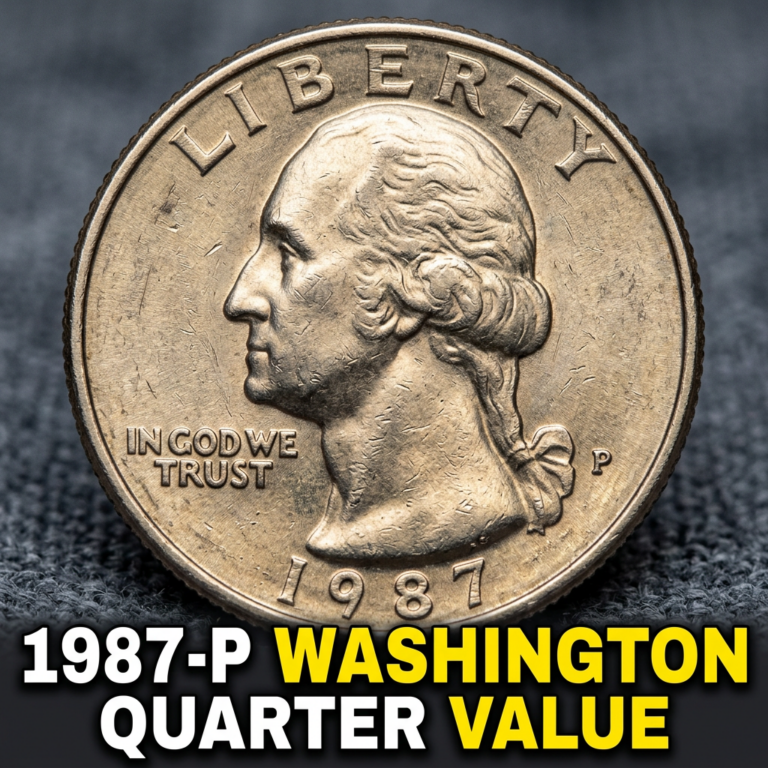
1987-S Kennedy Half Dollar Value: What Is Your Coin Worth?

Your Old Coin Could Be Valuable!
Identify It & Know Its Real Value — Free Download


The 1987-S Kennedy Half Dollar is worth anywhere from $3 in typical proof condition to over $100 for high-grade Deep Cameo specimens. While these coins were never released into general circulation, finding one in an old collection or a mint set can be a rewarding experience for any casual collector.
| Condition / Grade | Estimated Value |
|---|---|
| PR65 (Proof) | $3.00 – $5.00 |
| PR69 DCAM (Near Perfect) | $15.00 – $25.00 |
| PR70 DCAM (Perfect) | $80.00 – $150.00 |
Why the 1987-S Kennedy Half Dollar is Unique
If you have stumbled upon a 1987-S Kennedy Half Dollar, you are holding a piece of numismatic history that was never meant for your pocket change. In 1987, the United States Mint made the unusual decision not to strike any half dollars for general circulation. This means that unlike the coins from the 1970s or early 80s, you won’t find these sitting in a cash register. Instead, 1987 coins were only available in official Mint Sets and Proof Sets sold directly to collectors.
Because these were “NIFC” (Not Intended For Circulation), they are naturally scarcer than other years. The “S” mint mark indicates that the coin was struck at the San Francisco Mint specifically as a Proof coin. Proofs are manufactured using a specialized process where the coin blanks are polished and struck at least twice by specially prepared dies. This results in a mirror-like background and frosty details that make the portrait of John F. Kennedy stand out beautifully. If you aren’t sure if your coin is a proof, using the top coin identifier and value app can help you distinguish between various minting finishes in seconds.
For everyday Americans, the 1987 Kennedy Half Dollar represents a “hidden” year. Most people assume that if they don’t see a coin in circulation, it must be extremely rare. While the 1987-S isn’t a million-dollar rarity, its status as a collector-only issue gives it a baseline value that exceeds its 50-cent face value regardless of its condition. Using CoinKnow is a great way to track these NIFC issues in your personal collection and stay updated on market shifts.
Your Old Coin Could Be Valuable!
Identify It & Know Its Real Value — Free Download
Understanding the San Francisco Mint Mark and “S” Proofs
The San Francisco Mint has a long-standing reputation for producing the highest quality coins in the United States. Since 1975, the “S” mint mark on a Kennedy Half Dollar almost exclusively signifies a Proof coin intended for sets. When examining your 1987-S, look for the small “S” located just above the date, between Kennedy’s neck and the year. This mark is the key to identifying its origin and its specific strike type.
Your Old Coin Could Be Valuable!
Identify It & Know Its Real Value — Free Download
The 1987-S is characterized by its “Deep Cameo” (DCAM) finish. In the world of coin collecting, a Deep Cameo coin features a heavy contrast between the shiny, reflective fields (the flat parts) and the milky, white frosting on the devices (Kennedy’s head and the eagle on the back). To see how this finish impacts the market, you can check the current price trends for 1987 half dollars which highlights the premium that collectors are willing to pay for visual perfection.
Most 1987-S coins have remained in their original plastic protective lenses. However, if a coin was removed and handled, it may develop scratches or fingerprints that significantly lower its value. Collectors use a 70-point scale to grade these coins. A “Perfect 70” is the holy grail for a modern proof coin. Most 1987-S halves that are still in their original sets will grade between PR67 and PR69. If you want to see how these grades affect your bottom line, CoinKnow offers a simplified grading guide to help you estimate your coin’s score.
Your Old Coin Could Be Valuable!
Identify It & Know Its Real Value — Free Download
| Mint Mark | Strike Type | Mintage |
|---|---|---|
| 1987-P | Business Strike (NIFC) | 2,890,758 |
| 1987-D | Business Strike (NIFC) | 2,890,758 |
| 1987-S | Proof Strike | 4,227,728 |
Factors That Influence the 1987-S Half Dollar Market Value
When determining the price of a 1987-S Kennedy Half Dollar, three main factors come into play: Eye appeal, the presence of milk spots, and professional certification. Unlike silver coins from 1964 or 40% silver coins from 1965-1970, the 1987-S is made of a copper-nickel clad composition. This means its value isn’t tied to the price of silver bullion, but rather to its numismatic rarity and beauty.
“Milk spots” are a common problem with 1980s proof coins. These are white, cloudy spots that appear on the surface of the coin due to cleaning agents used at the Mint not being fully rinsed off before striking. A 1987-S with heavy milk spotting is usually only worth its face value or a few dollars. Conversely, a “clean” coin with no spots and deep mirrors can fetch a significant premium. For a detailed breakdown of what makes a coin truly valuable, you can read more about the 1987 Kennedy Half Dollar appraisal data.
Professional grading by companies like PCGS or NGC is the primary way to unlock high values. A 1987-S certified as a PR70 Deep Cameo—meaning it is flawless under 5x magnification—is a rare find. While over 4 million 1987-S proofs were minted, only a small fraction have survived without any microscopic flaws. For the average person, using CoinKnow can help you decide if it is worth the $20-$40 fee to have your coin professionally graded.
Your Old Coin Could Be Valuable!
Identify It & Know Its Real Value — Free Download
| Grade | Rarity Factor | Market Price |
|---|---|---|
| PR67 DCAM | Common | $6 – $10 |
| PR68 DCAM | Average | $12 – $18 |
| PR69 DCAM | High Quality | $20 – $35 |
| PR70 DCAM | Elite/Rare | $100+ |
The 1987 Half Dollar Error List: What to Look For
While the 1987-S coins were closely inspected at the San Francisco Mint, errors still occasionally slip through. One of the most common errors to look for in proof coins is “doubled die” varieties. A doubled die occurs when the coin hub imprints an image twice onto the die at slightly different angles. On a 1987-S Kennedy, check the lettering in the word “LIBERTY” or the date for any slight thickening or “secondary” lines.
Another error seen in proof sets is the “Off-Center” strike, though this is extremely rare for proof coins. More common are “Strike Through” errors, where a piece of debris or grease gets between the die and the coin, leaving a faint indent or a blurry spot on the design. Because 1987 halves were not meant for circulation, any error found on them is automatically more desirable to collectors than an error on a high-mintage year like 1971 or 1976.
If you think you’ve found an error, compare your coin to high-resolution photos in CoinKnow. Remember that “post-mint damage” (scratches or dings that happened after the coin was made) is often confused for an error by beginners. A true mint error must have occurred during the manufacturing process.
Your Old Coin Could Be Valuable!
Identify It & Know Its Real Value — Free Download
How to Store and Protect Your 1987-S Kennedy Half Dollar
Because the value of a 1987-S is almost entirely dependent on its surface condition, proper storage is vital. If you found your coin in its original 1987 Proof Set (the blue cardboard envelope with the plastic lens), the best thing you can do is leave it exactly where it is. Breaking the coin out of its original packaging can expose it to humidity and oils from your skin, which will quickly tarnish the mirror-like finish.
If your coin is already “loose,” do not try to clean it! This is the most common mistake new collectors make. Wiping a proof coin with a cloth, even a soft one, will create “hairline” scratches that can be seen under a magnifying glass. These scratches significantly devalue the coin. Instead, place it in a PVC-free “flip” or a plastic capsule designed specifically for half dollars.
Keeping your coins in a cool, dry place is essential. Moisture can cause the copper-nickel cladding to develop unsightly toning or dark spots. By preserving the “Deep Cameo” look of your 1987-S, you ensure that it remains a liquid asset that can be easily sold to a coin dealer or another collector in the future.
FAQ
Q: Is the 1987-S Kennedy Half Dollar made of silver?
A: No, the 1987-S Kennedy Half Dollar is a copper-nickel clad coin. The U.S. Mint stopped using silver for standard proof half dollars in 1970. While it may look shiny like silver, its value comes from its rarity and condition rather than metal content.
Your Old Coin Could Be Valuable!
Identify It & Know Its Real Value — Free Download
Q: Can I find a 1987-S in my pocket change?
A: It is highly unlikely. Since these were only sold in Proof Sets to collectors, they were never released into circulation. However, sometimes people “spend” these sets by mistake, so it is possible to find one, but it would be considered a major “find.”
Q: What is the highest price ever paid for a 1987-S Half Dollar?
A: While common PR69 examples sell for under $30, a perfect PR70 Deep Cameo specimen can sell for over $150 at major auctions. The price depends entirely on the grading company’s certification and the current demand among Registry Set collectors.
Q: How do I know if my 1987 half dollar is a “P”, “D”, or “S”?
A: Look on the obverse (front) of the coin, just above the date. You will see a small letter. “P” stands for Philadelphia, “D” for Denver, and “S” for San Francisco. All 1987 halves are somewhat rare because none were made for general circulation.