
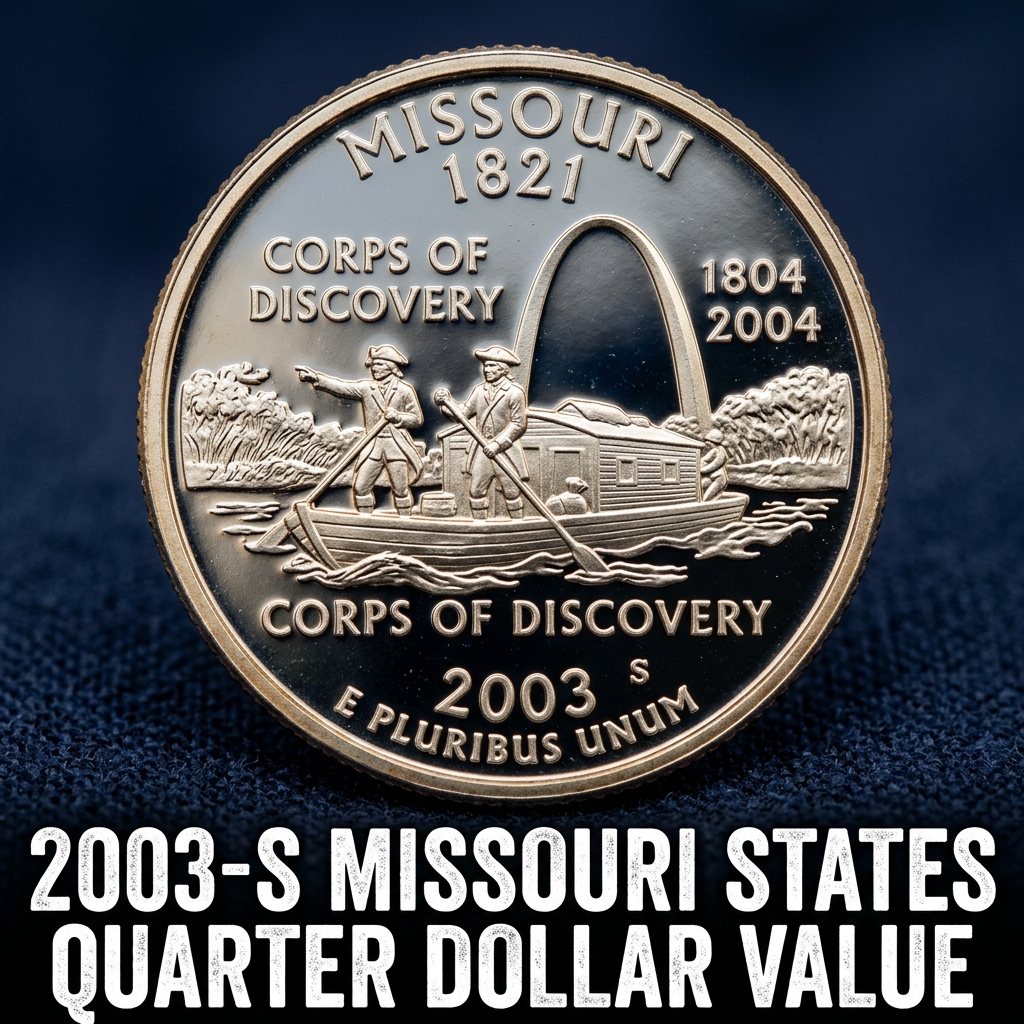
2003-S Missouri State Quarter Dollar Value What Collectors and Everyday Finders Should Know

Your Old Coin Could Be Valuable!
Identify It & Know Its Real Value — Free Download


The 2003-S Missouri State Quarter is worth anywhere from $1 to $10 in typical proof condition, with top-grade examples and special varieties reaching $25 or more among serious collectors. If you pulled one of these silver-tinted quarters from an old coin jar or inherited a proof set, you may be sitting on more than face value — and this guide will walk you through exactly what that means for you.
What Is the 2003-S Missouri State Quarter?
The 2003-S Missouri State Quarter was struck at the San Francisco Mint as part of the long-running 50 State Quarters Program, which ran from 1999 to 2008. The “S” mintmark tells you right away that this coin was made specifically for collectors — not for everyday circulation. That distinction matters a lot when it comes to value.
Missouri was the 24th state admitted to the Union, and its quarter design reflects that history beautifully. The reverse features the Gateway Arch with the Lewis and Clark expedition keelboat passing beneath it, along with the inscription “Corps of Discovery.” It’s a design that resonates with American history lovers.
If you’re not sure whether your coin is a genuine proof issue or something else entirely, using a coin identifier and value app can instantly help you confirm the coin’s identity, mintmark, and estimated market value right from your phone.
Your Old Coin Could Be Valuable!
Identify It & Know Its Real Value — Free Download
How Much Is the 2003-S Missouri Quarter Worth Today
The value of the 2003-S Missouri State Quarter depends largely on whether it’s a clad proof or a silver proof, and what grade it receives. Standard clad proof coins are worth around $1 to $5 in average condition, while deeply cameo examples in PR-69 or PR-70 can fetch $8 to $25.
The silver proof version — struck in 90% silver — is notably more valuable. These were sold in special Silver Proof Sets and carry both numismatic and precious metal value. A silver 2003-S Missouri quarter in PR-69 DCAM typically sells for $10 to $20, and PR-70 examples can exceed $30 to $40.
Your Old Coin Could Be Valuable!
Identify It & Know Its Real Value — Free Download
Here’s a quick value reference table to help you understand where your coin might fall:
Your Old Coin Could Be Valuable!
Identify It & Know Its Real Value — Free Download
| Coin Type | Grade | Estimated Value |
|---|---|---|
| Clad Proof | PR-65 | $1 – $3 |
| Clad Proof Deep Cameo | PR-69 DCAM | $5 – $12 |
| Clad Proof Deep Cameo | PR-70 DCAM | $15 – $25 |
| Silver Proof | PR-69 DCAM | $10 – $20 |
| Silver Proof | PR-70 DCAM | $30 – $45 |
For real-time auction results and certified coin sales data, you can explore recent State Quarter price trends across certified grades to see where the market currently stands.
Clad vs Silver Proof — Which One Do You Have
A lot of people don’t realize there are two different versions of the 2003-S Missouri Quarter. The clad version is made from copper-nickel and came in the standard annual Proof Set sold by the U.S. Mint. The silver version was part of a separate Silver Proof Set and contains 90% silver.
The easiest way to tell them apart at a glance is by looking at the coin’s edge. A clad coin will show a visible copper stripe in the middle of the edge. A silver proof will have a uniform silver-white edge with no stripe at all.
Your Old Coin Could Be Valuable!
Identify It & Know Its Real Value — Free Download
If you’re unsure, weigh the coin. A silver 2003-S Missouri quarter weighs about 6.25 grams, while a clad version weighs approximately 5.67 grams. A kitchen scale or postage scale can sometimes make this distinction quickly. You can also use CoinKnow to scan and identify your coin’s composition in seconds.
What Affects the Value of Your 2003-S Missouri State Quarter
Several factors influence the final value of any 2003-S Missouri quarter. The most important is the coin’s grade — specifically whether it qualifies as a “Deep Cameo” or “Ultra Cameo” designation, which refers to the frosted, mirror-like contrast between the raised design and the flat fields.
Coins with flawless surfaces and the sharpest cameo contrast are the most desirable. Even a single tiny hairline scratch from mishandling can drop a coin from a PR-70 grade to PR-69, which can cut the value in half in some cases.
Storage also matters. Coins kept in original mint packaging or certified slabs from PCGS or NGC hold value better than raw coins rattling around in a drawer. If you’re serious about selling or collecting, having your coin professionally graded is often worth the cost. For a broader look at what 2003 quarters are worth across different mint marks and grades, comparing multiple issues side by side can be very helpful.
Your Old Coin Could Be Valuable!
Identify It & Know Its Real Value — Free Download
CoinKnow also offers a grading estimation tool that gives you a ballpark grade before you send your coin in for official certification, which can save you money and time.
Should You Sell, Keep, or Get It Graded
If you found a 2003-S Missouri State Quarter still in its original proof set packaging, the best move is usually to keep it sealed. Removing it from the packaging almost always reduces its collector appeal and can affect value.
If you have a loose silver proof in excellent condition, it may be worth sending to PCGS or NGC for grading, especially if you believe it qualifies as a PR-70. That certification can significantly boost the selling price on eBay or at a coin show.
For most casual finders, though, the coin is a cool piece of American history worth a few dollars. Enjoy it, do a little research, and use tools like CoinKnow to make informed decisions before you sell or trade anything.
Your Old Coin Could Be Valuable!
Identify It & Know Its Real Value — Free Download
FAQ
Q: How do I know if my 2003-S Missouri Quarter is silver or clad?
A: Check the edge of the coin. A silver proof will have a solid white edge with no visible copper stripe. A clad coin will show a reddish-brown copper layer in the middle. You can also weigh it — silver versions weigh about 6.25 grams versus 5.67 grams for clad.
Q: Is a 2003-S Missouri Quarter worth more if it’s still in the original proof set?
A: Yes, generally speaking. Keeping the coin in its original sealed packaging preserves its condition and collector appeal. An opened or removed coin may be worth slightly less unless it has been professionally graded and slabbed by PCGS or NGC.
Q: Where is the best place to sell a 2003-S Missouri State Quarter?
A: eBay is one of the most popular platforms for selling proof state quarters, especially certified ones. Coin shows, local dealers, and online coin forums are also good options. Make sure to research recent sold listings before setting a price.