
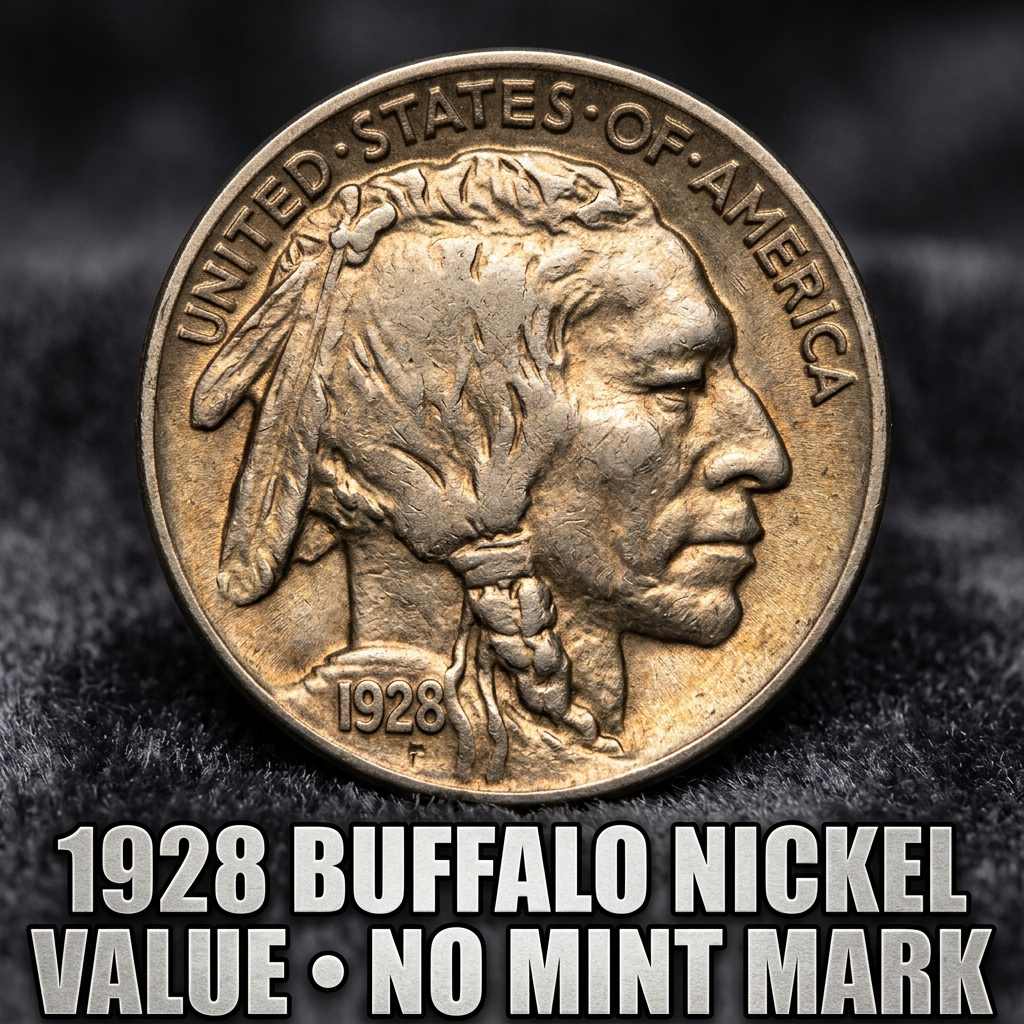
1928 Buffalo Nickel Value No Mint Mark What Is It Worth Today

Your Old Coin Could Be Valuable!
Identify It & Know Its Real Value — Free Download


The 1928 Buffalo Nickel with no mint mark is worth anywhere from $1 to $2 in heavily worn condition, up to $100 or more in well-preserved mint state grades. If you found one of these old nickels in a drawer or coin jar, you might be sitting on more than pocket change — especially if it still shows sharp details on the buffalo’s back and the Indian’s cheekbone.
What the 1928 No Mint Mark Buffalo Nickel Really Is
The 1928 Philadelphia Mint Buffalo Nickel — also called the Indian Head Nickel — was struck without a mint mark, which was standard practice for coins made in Philadelphia at the time. That year, the Philadelphia Mint produced over 23 million of these five-cent pieces, making the no-mint-mark version the most common of the three 1928 issues (the others came from Denver and San Francisco).
The coin was designed by James Earle Fraser and features a bold portrait of a Native American chief on the obverse and a bison standing on a raised mound on the reverse. It’s one of the most beloved American coin designs ever made.
If you’re not sure whether your coin has a mint mark or not, or if you want a quick identification, a coin identifier and value app can scan the coin using your phone camera and tell you the mint mark location, grade estimate, and current market value in seconds.
Your Old Coin Could Be Valuable!
Identify It & Know Its Real Value — Free Download
How Much Is the 1928 Buffalo Nickel Worth Without a Mint Mark
The value of a 1928 Buffalo Nickel with no mint mark depends almost entirely on its condition. A coin that’s been in circulation for decades will show heavy wear — the date may be faded, the horn on the buffalo nearly gone, and the facial features flat. These well-worn coins are still collectible but fetch modest prices.
Your Old Coin Could Be Valuable!
Identify It & Know Its Real Value — Free Download
As coins move up in grade — from Fine to Extremely Fine to Mint State — values climb sharply. A coin graded MS-65 by PCGS or NGC can sell for $100 to $200, and gem examples in MS-66 have been known to cross $300 at auction.
Here’s a quick value guide based on grade:
Your Old Coin Could Be Valuable!
Identify It & Know Its Real Value — Free Download
| Grade | Description | Estimated Value |
|---|---|---|
| Good (G-4) | Heavy wear, date visible | $1 – $2 |
| Fine (F-12) | Moderate wear, some detail | $5 – $8 |
| Extremely Fine (EF-40) | Light wear on high points | $18 – $30 |
| About Uncirculated (AU-55) | Slight trace of wear | $40 – $60 |
| MS-63 | Uncirculated, minor marks | $75 – $100 |
| MS-65 | Gem uncirculated | $150 – $225 |
For up-to-date auction results and certified coin prices, you can check the latest 1928 Buffalo Nickel MS grade price data to see exactly what collectors are paying right now.
How to Tell the Grade of Your 1928 Buffalo Nickel
Grading a Buffalo Nickel at home takes a little practice, but there are a few easy checkpoints to look for. First, examine the date. On worn coins, the “1928” can become faint or even disappear entirely on very low-grade pieces.
Next, look at the horn on the buffalo. On a Fine-grade coin, the horn is visible but flat. On an Extremely Fine example, the horn is sharp with clear separation. On an uncirculated coin, the horn is bold and fully rounded with no trace of wear at all.
Your Old Coin Could Be Valuable!
Identify It & Know Its Real Value — Free Download
Also check the cheekbone and brow of the Indian on the obverse. High-grade coins show sharp, defined facial features. Circulated coins show a smooth, flattened look in those areas.
Using CoinKnow to photograph your coin in good natural lighting can help you compare your example to certified grading standards. The app gives you an instant visual match and grade estimate — perfect for beginners who don’t have a price guide handy.
What Makes Some 1928 Buffalo Nickels More Valuable
While the Philadelphia issue is the most common, condition is king when it comes to value. Strike quality also matters — some 1928 Philly coins came out weakly struck, meaning details like the hair braid and the buffalo’s fur weren’t fully formed even when new. A fully struck, sharply detailed coin commands a premium.
Your Old Coin Could Be Valuable!
Identify It & Know Its Real Value — Free Download
Eye appeal also plays a role. Coins with original skin (natural, undipped surfaces) and attractive coloring tend to sell above standard price guide values.
If you want a full breakdown of 1928 Buffalo Nickel value by grade, date, and mint mark variety, this detailed 1928 Buffalo Nickel value guide walks you through everything you need to know before selling or holding your coin.
For everyday collectors, CoinKnow is a fast and reliable way to get a market-based valuation for your coin without needing to visit a dealer or dig through auction records manually.
—
Your Old Coin Could Be Valuable!
Identify It & Know Its Real Value — Free Download
Frequently Asked Questions
Q: Is a 1928 Buffalo Nickel with no mint mark rare?
A: Not particularly. With over 23 million minted in Philadelphia, the 1928 no-mint-mark Buffalo Nickel is the most common of the three 1928 issues. That said, high-grade uncirculated examples are much scarcer and carry strong collector value.
Q: Where is the mint mark on a 1928 Buffalo Nickel?
A: On Buffalo Nickels, the mint mark appears on the reverse side, just below the words “FIVE CENTS.” If there’s no letter there, the coin was made at the Philadelphia Mint and carries no mint mark.
Q: Should I clean my 1928 Buffalo Nickel before selling it?
A: No — never clean an old coin. Cleaning removes the natural patina and surface metal, which drastically reduces its value to collectors. Even a coin that looks dirty is worth more uncleaned than one that’s been polished or wiped.