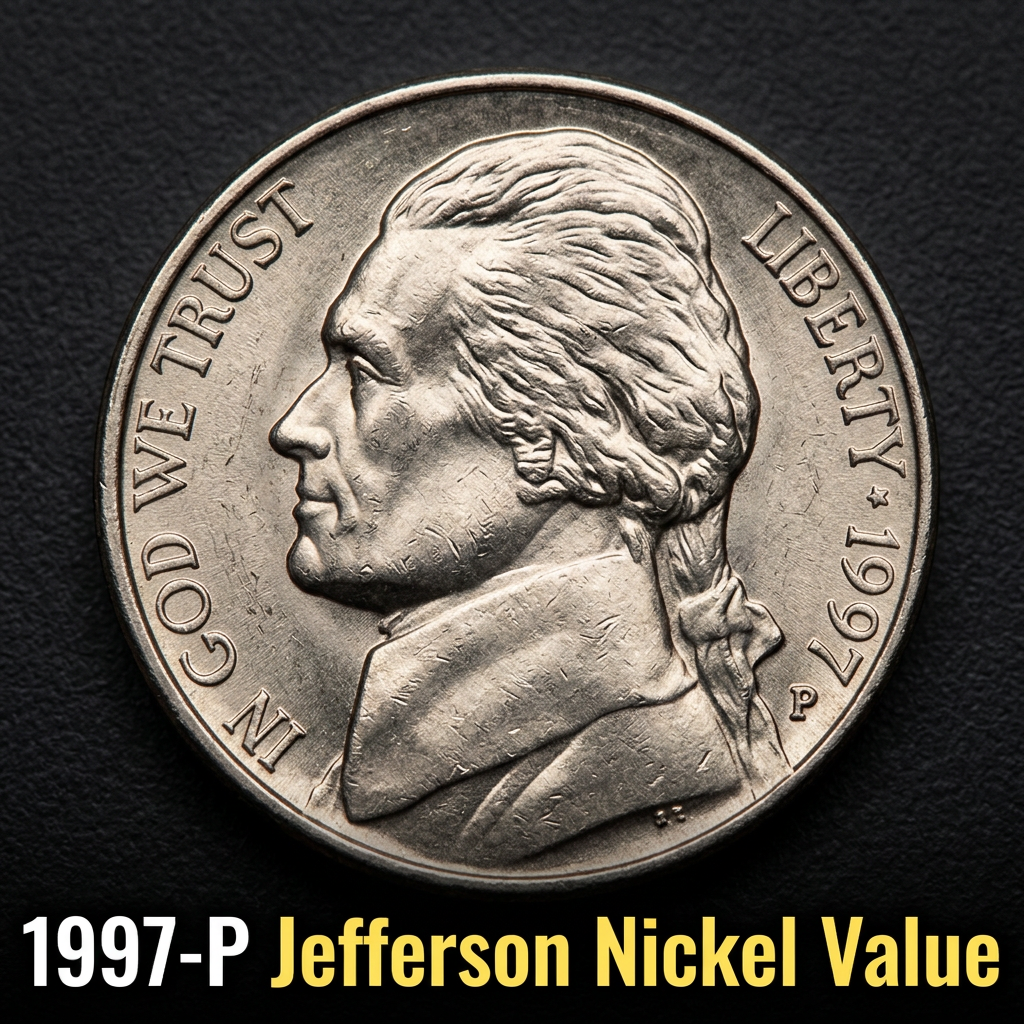
1997-P Jefferson Nickel Value What It’s Worth and Why Collectors Care

Your Old Coin Could Be Valuable!
Identify It & Know Its Real Value — Free Download


The 1997-P Jefferson Nickel is worth anywhere from 5 cents in heavily worn condition to around $15 to $30 or more in uncirculated mint state grades. If you found one in your change jar or an old coin collection, this guide will help you figure out exactly what you’re holding.
What Is the 1997-P Jefferson Nickel?
The “P” in 1997-P stands for Philadelphia, one of the main U.S. Mint facilities that produces coins for circulation. In 1997, the Philadelphia Mint struck millions of Jefferson Nickels, making this a fairly common date in the series.
That said, common doesn’t always mean worthless. The value of any coin depends heavily on its condition, and a 1997-P Nickel in pristine, uncirculated condition can still bring a nice premium over face value.
If you’re not sure how to identify your coin or check its grade at home, a coin identifier and value app can be a fast and reliable way to get started. These tools use your phone’s camera to analyze the coin and give you an estimated value based on current market data.
Your Old Coin Could Be Valuable!
Identify It & Know Its Real Value — Free Download
How Much Is the 1997-P Jefferson Nickel Worth?
For most people who find a 1997-P Nickel in everyday change, the coin is worth face value — 5 cents — because it’s been circulated and shows wear. However, coins that were saved directly from mint rolls and never spent can be worth significantly more.
Here’s a general value breakdown based on condition:
Your Old Coin Could Be Valuable!
Identify It & Know Its Real Value — Free Download
| Grade / Condition | Description | Estimated Value |
|---|---|---|
| Good (G-4) | Heavy wear, design visible | Face value ($0.05) |
| Fine (F-12) | Moderate wear, clear details | $0.05 – $0.10 |
| Extremely Fine (EF-40) | Light wear on high points | $0.25 – $0.50 |
| Uncirculated (MS-63) | No wear, some contact marks | $1 – $3 |
| Gem Uncirculated (MS-65) | Bright luster, minimal marks | $5 – $15 |
| Superior Gem (MS-67+) | Nearly perfect, top-tier grade | $20 – $30+ |
For the most up-to-date market pricing, you can check current 1997-P Jefferson Nickel prices across MS grades to see how recently graded examples have sold at auction.
Your Old Coin Could Be Valuable!
Identify It & Know Its Real Value — Free Download
Factors That Affect the 1997-P Nickel’s Value
Coin grading is the single biggest factor in determining what your 1997-P Jefferson Nickel is worth. Even a tiny difference in grade — say, MS-65 versus MS-67 — can mean a significant jump in dollar value, especially for modern coins where high-grade examples are scarcer than you’d think.
Beyond grade, eye appeal matters too. Collectors look for coins with full, sharp strikes (especially on Jefferson’s hair detail and Monticello’s steps), original luster, and no distracting scratches or spots.
Toning can work both ways — natural, attractive toning sometimes adds value, while dark or blotchy spots usually hurt it.
Your Old Coin Could Be Valuable!
Identify It & Know Its Real Value — Free Download
Strike quality is another thing to watch. Some 1997-P Nickels show “Full Steps” on Monticello, meaning all five or six steps on the building’s entrance are completely visible and separated. A coin certified as “Full Steps” (FS) by a grading service like PCGS or NGC will often sell for a notable premium above standard examples of the same grade.
Should You Get Your 1997-P Nickel Graded?
If your coin looks brilliant and untouched — no wear, strong luster, no visible marks — it might be worth having it professionally graded. Services like PCGS and NGC charge anywhere from $20 to $50+ per coin, so it only makes financial sense if you believe the coin could grade MS-66 or higher.
For a quick at-home assessment before spending money on grading fees, CoinKnow is a smart first step. CoinKnow lets you scan your coin, get an instant grade estimate, and see current market value — all from your phone.
Your Old Coin Could Be Valuable!
Identify It & Know Its Real Value — Free Download
You can also explore detailed value information for the 1997 Jefferson Nickel including both circulated and uncirculated price ranges, to help you decide if professional grading is worth pursuing.
Is the 1997-P Jefferson Nickel Rare?
In short, no — the 1997-P Jefferson Nickel is not rare. The Philadelphia Mint produced hundreds of millions of them, so finding one in circulation is easy. However, finding one in true gem uncirculated condition with Full Steps is actually harder than you might expect, which is why top-grade examples do carry collector interest.
The 1997 date is not considered a key date or a semi-key in the Jefferson Nickel series, so even serious collectors don’t usually pay a premium just for the date itself. Value is driven almost entirely by grade and strike quality.
If you’re building a Jefferson Nickel set by date and mint mark, the 1997-P is an affordable and easy coin to acquire. Just pick the nicest example you can find and afford. CoinKnow can help you compare options and make sure you’re not overpaying.
Your Old Coin Could Be Valuable!
Identify It & Know Its Real Value — Free Download
FAQ
Q: How do I know if my 1997-P Jefferson Nickel has Full Steps?
A: Look at the base of Monticello on the reverse side of the coin. Count the horizontal lines that represent the steps leading to the building’s entrance. If you can see five or six complete, fully separated steps with no breaks or merging, your coin may qualify for the Full Steps designation. A magnifying glass or loupe helps a lot here.
Q: Is a 1997-P Nickel worth keeping?
A: If it’s circulated and shows wear, it’s worth face value and likely not worth saving unless you’re building a date set. But if the coin is uncirculated, bright, and sharp, it’s worth holding onto — especially if it shows Full Steps, as those coins can sell for multiples of what a standard uncirculated example brings.
Q: Where is the mint mark on a 1997-P Jefferson Nickel?
A: On Jefferson Nickels made from 1980 onward, the mint mark appears on the obverse (front) side of the coin, just to the right of Jefferson’s portrait. On the 1997-P, you’ll see a small “P” in that location, confirming it was struck at the Philadelphia Mint.