2011-S Olympic Quarter Worth More Than You Think

Your Old Coin Could Be Valuable!
Identify It & Know Its Real Value — Free Download


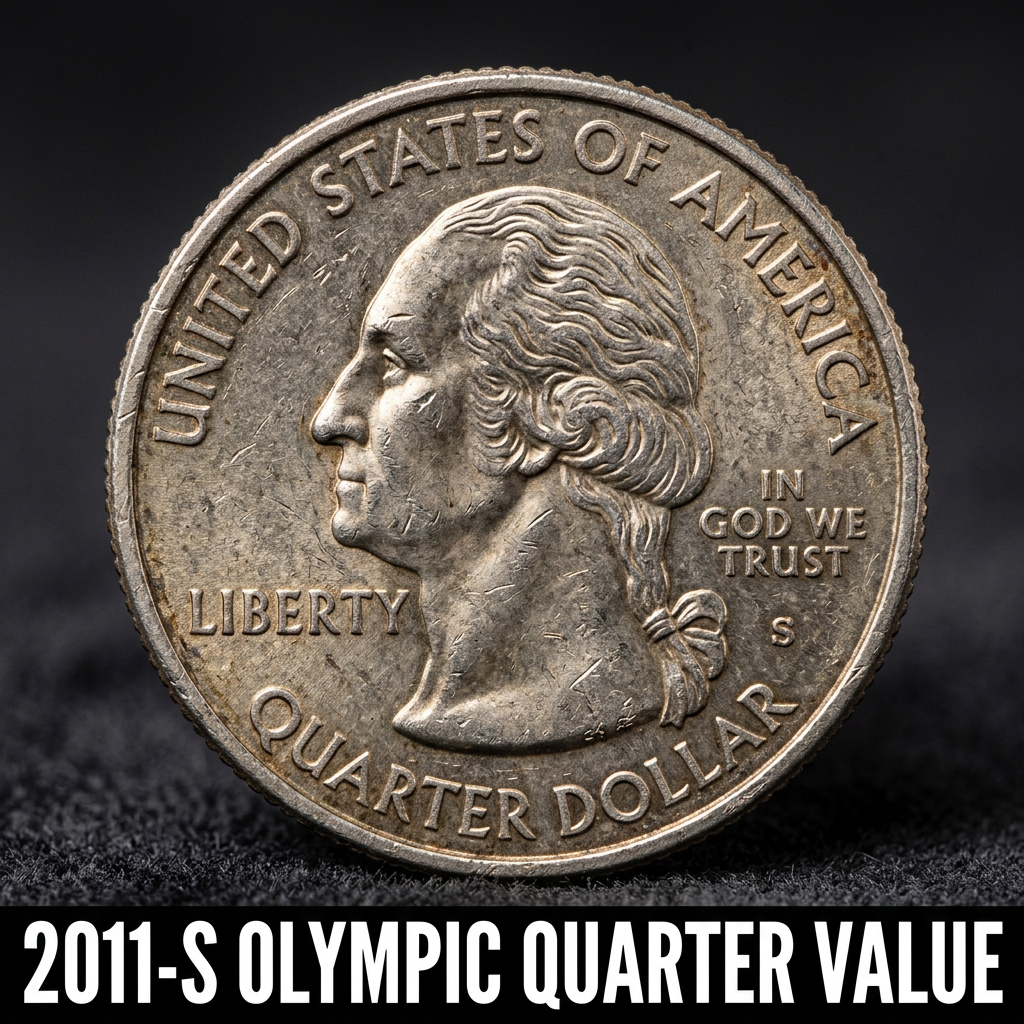
The 2011-S Olympic National Park Quarter is worth anywhere from $1 to $5 in typical circulated condition, but proof versions can fetch $8 to $25 or more depending on their grade and finish. If you found one of these quarters in your change or a coin collection, you’re in the right place to find out exactly what it’s worth.
What Is the 2011-S Olympic Quarter?
The 2011-S Olympic Quarter is part of the America the Beautiful Quarters Program, a series launched by the U.S. Mint in 2010 to honor national parks and historic sites across all 50 states and territories. The Olympic design represents Olympic National Park in Washington State, featuring a stunning image of a Roosevelt elk standing in a forest landscape.
The “S” mint mark tells you this coin was struck at the San Francisco Mint. Unlike the Philadelphia (P) and Denver (D) versions made for general circulation, the San Francisco Mint produced two special versions of this quarter — a clad proof and a silver proof. These collector-quality coins were never released into everyday circulation, which makes them more desirable to collectors.
If you want to quickly identify your coin and get an instant value estimate, using a coin identifier and value app is one of the easiest ways to get started without needing any prior coin knowledge.
Your Old Coin Could Be Valuable!
Identify It & Know Its Real Value — Free Download
How Much Is the 2011-S Olympic Quarter Worth Today
The value of your 2011-S Olympic Quarter depends heavily on which version you have and its condition. There are two distinct types from the San Francisco Mint — the clad proof and the 90% silver proof — and they carry different price tags.
The clad proof version, made from the standard copper-nickel composition, is the more common of the two. In PR-65 condition, these typically sell for around $3 to $6. Step up to a perfect PR-70 grade and you could see prices in the $15 to $25 range, especially in deep cameo (DCAM) designation.
Your Old Coin Could Be Valuable!
Identify It & Know Its Real Value — Free Download
The silver proof version is where things get more exciting. Struck in 90% silver, these coins are more sought after by collectors. A PR-65 silver proof might bring $8 to $15, while top-grade PR-70 DCAM examples have sold for $30 to $50 or even higher through major auction houses. You can explore detailed 2011 quarter value breakdowns by grade and mint mark to compare prices across all versions of this coin.
Your Old Coin Could Be Valuable!
Identify It & Know Its Real Value — Free Download
| Version | Grade | Estimated Value |
|---|---|---|
| Clad Proof (S) | PR-65 DCAM | $3 – $6 |
| Clad Proof (S) | PR-70 DCAM | $15 – $25 |
| Silver Proof (S) | PR-65 DCAM | $8 – $15 |
| Silver Proof (S) | PR-70 DCAM | $30 – $50+ |
How to Tell If You Have the Silver Version
This is a question a lot of people ask, and it’s a fair one. The silver proof and the clad proof look very similar at first glance. One quick way to check is to look at the edge of the coin. A silver proof will show a solid silver-colored edge with no copper stripe running through the middle. The standard clad coin has a visible reddish-copper layer sandwiched between two silver-toned layers.
You can also check the weight. A silver proof 2011-S Olympic Quarter weighs about 6.25 grams, while the clad version weighs 5.67 grams. A precise digital scale can help you tell the difference quickly.
If you’re still unsure, CoinKnow is a handy tool that can analyze your coin using your smartphone camera and give you detailed information about composition, mint mark, and estimated value in seconds.
Your Old Coin Could Be Valuable!
Identify It & Know Its Real Value — Free Download
Factors That Affect the 2011-S Olympic Quarter Value
Even within the same version and grade, prices can vary. A few key factors influence what a buyer is willing to pay.
First, the cameo contrast matters. Proof coins with strong frosted devices against a mirror-like background — called deep cameo or ultra cameo — command higher premiums. A coin with flat, washed-out contrast is worth significantly less than one with dramatic visual depth.
Second, original packaging and documentation add value. If your coin is still sealed in its original U.S. Mint proof set or silver proof set, it’s considered more desirable. Breaking it out of the original holder can actually reduce its market appeal.
Your Old Coin Could Be Valuable!
Identify It & Know Its Real Value — Free Download
Third, certified coins sell for more. A coin graded and encapsulated by PCGS or NGC gives buyers confidence in its authenticity and condition. For coins approaching PR-68 or higher, third-party grading is often worth the cost. You can also check current market prices for America the Beautiful Quarters across different grades and mint marks to get a better sense of how condition drives value.
Is the 2011-S Olympic Quarter Worth Keeping
For most everyday finds, the 2011-S Olympic Quarter isn’t going to retire you early. But it’s still a quality coin with real collector interest, especially the silver proof version. If you happen to have a pristine example in its original mint packaging, it’s absolutely worth holding onto or having graded.
Even if your coin is just a standard clad proof, it’s a beautiful piece of American history celebrating one of the Pacific Northwest’s most breathtaking natural treasures. CoinKnow makes it simple to log your collection, track current values, and decide whether to sell, hold, or grade your coins.
The America the Beautiful series is well-loved by modern coin collectors, and the Olympic Park design is considered one of the more attractive issues from the 2011 lineup. It’s the kind of coin that casual collectors and serious numismatists both appreciate.
Your Old Coin Could Be Valuable!
Identify It & Know Its Real Value — Free Download
FAQ
Q: How many 2011-S Olympic Quarters were made?
A: The U.S. Mint produced approximately 1.27 million clad proof 2011-S Olympic Quarters and around 722,000 silver proof versions. While these are not rare coins, the silver proofs are less common and carry more value among collectors.
Q: Can I find a 2011-S Olympic Quarter in everyday pocket change?
A: No. The “S” mint mark versions were only sold directly through the U.S. Mint in proof sets. They were never released into general circulation. If you’re finding quarters in change, those would be the P or D mint mark versions, which are worth face value in worn condition.
Q: Should I clean my 2011-S Olympic Quarter before selling it?
A: Absolutely not. Cleaning a coin — even gently — removes the original surface and dramatically reduces its numismatic value. Collectors and grading services can easily detect cleaning, and a cleaned coin will receive a “details” designation that significantly lowers what buyers will pay. Always store proof coins in their original holders and handle them by the edges only. CoinKnow can help you understand proper coin care and storage best practices for keeping your collection in top condition.