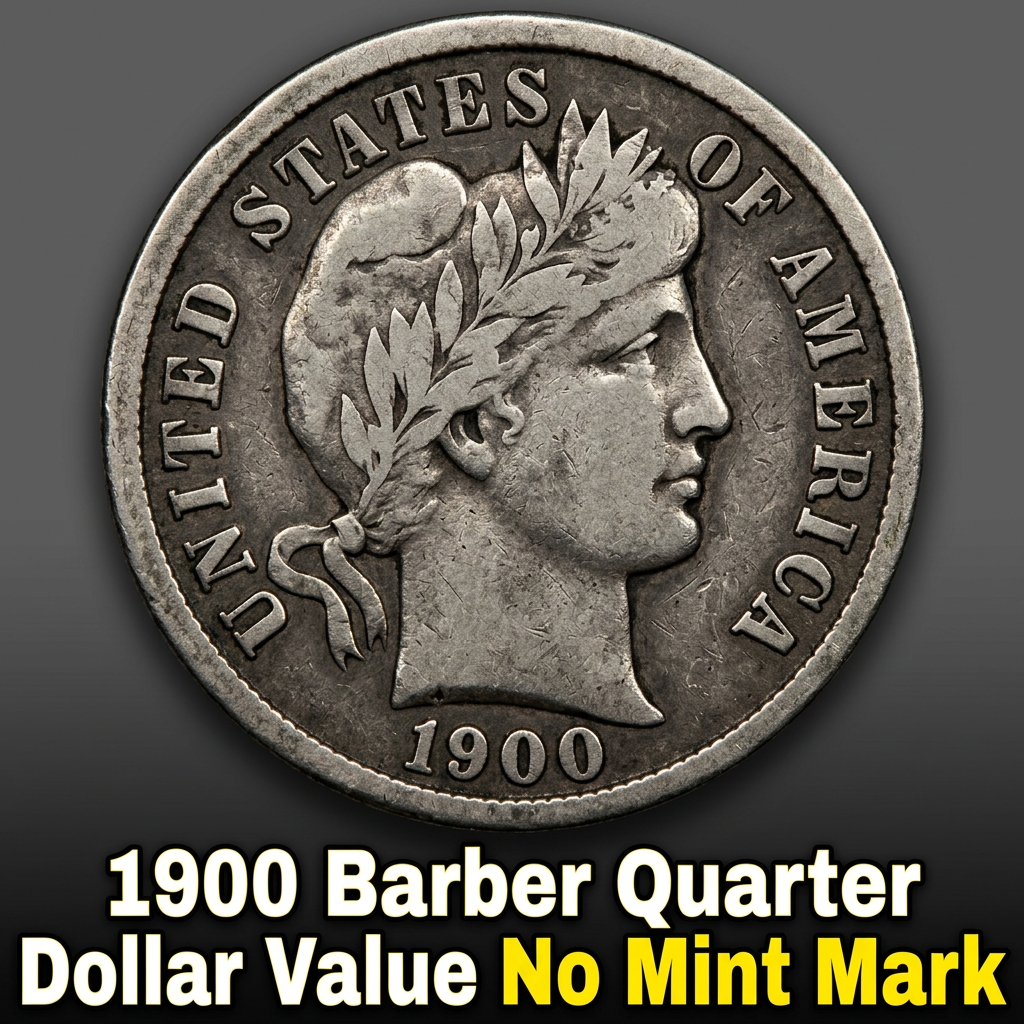
1900 Barber Quarter Dollar Value No Mint Mark What Is It Worth

Your Old Coin Could Be Valuable!
Identify It & Know Its Real Value — Free Download


The 1900 Barber Quarter Dollar (no mint mark) is worth anywhere from $6 to $15 in heavily worn condition, climbing to $50 or more in fine grades, and potentially reaching several hundred dollars in mint state examples. If you found one of these silver coins in an old collection or coin jar, you’re holding a piece of American history worth knowing about.
What Is the 1900 Barber Quarter Dollar?
The 1900 Barber Quarter is part of a classic series designed by U.S. Mint Chief Engraver Charles E. Barber. The obverse features Lady Liberty wearing a laureate crown, while the reverse displays a heraldic eagle — a design that ran from 1892 through 1916.
The no mint mark version was struck at the Philadelphia Mint, which was standard practice at the time. Philadelphia coins carried no mint mark, so if your coin has nothing below the eagle on the reverse, it came from Philadelphia.
These coins are made of 90% silver, which gives them an intrinsic metal value of roughly $4 to $5 just for the silver content alone, depending on current spot prices. If you want to quickly identify and grade your coin, tools like a coin identifier and value app can help you get a fast, accurate read without needing to visit a dealer right away.
Your Old Coin Could Be Valuable!
Identify It & Know Its Real Value — Free Download
How Much Is the 1900 Barber Quarter Worth Today?
The value of your 1900 Barber Quarter depends heavily on its condition. Coin collectors grade coins on a scale from AG (About Good) all the way to MS (Mint State), and even small differences in wear can mean big differences in price.
Most circulated examples you find in the wild will fall in the Good to Fine range, showing clear major design elements but with worn details. These are the most common grades and fetch modest but real money.
Your Old Coin Could Be Valuable!
Identify It & Know Its Real Value — Free Download
Higher-grade examples with sharp details and minimal wear are far rarer and much more valuable to serious collectors. Check out this guide on 1900 silver dollar and related coin values to better understand how silver coinage from this era is priced.
Your Old Coin Could Be Valuable!
Identify It & Know Its Real Value — Free Download
| Grade | Description | Estimated Value |
|---|---|---|
| AG-3 (About Good) | Heavily worn, outline visible | $5 – $7 |
| G-4 (Good) | Major details clear, flat surfaces | $7 – $10 |
| VG-8 (Very Good) | Some detail remaining | $12 – $18 |
| F-12 (Fine) | Moderate wear, readable lettering | $20 – $35 |
| VF-20 (Very Fine) | Light wear on high points | $40 – $65 |
| EF-40 (Extremely Fine) | Slight wear on highest points only | $80 – $130 |
| MS-60 (Mint State) | No wear, possible bag marks | $175 – $250 |
| MS-63 (Choice Mint State) | Lustrous, minor contact marks | $300 – $450 |
| MS-65 (Gem Mint State) | Full luster, sharp strike | $700+ |
Key Factors That Affect the 1900 Barber Quarter No Mint Mark Value
Beyond grade, a few other things influence what your 1900 Barber Quarter is actually worth on the market.
Strike quality matters a lot with Barber Quarters. Weakly struck coins — which happened more often than collectors would like — can lose value even at higher grades. Look for sharp detail in Liberty’s hair and the eagle’s feathers.
Eye appeal is another factor dealers and collectors weigh. A coin with original skin (natural toning, no cleaning) will almost always sell for more than a polished or cleaned example of the same technical grade. Cleaning is one of the biggest value killers in coin collecting.
Your Old Coin Could Be Valuable!
Identify It & Know Its Real Value — Free Download
Certification through PCGS or NGC can significantly boost buyer confidence and resale value, especially for coins in VF or better condition. Using CoinKnow to pre-screen your coin before sending it off for grading is a smart first step — it helps you decide whether grading costs are worth it.
How to Identify Your 1900 Barber Quarter
Identification is simple once you know what to look for. On the obverse, you’ll see the date 1900 clearly at the bottom, with “IN GOD WE TRUST” arching above Liberty’s portrait. The reverse shows “UNITED STATES OF AMERICA” around the top and “QUARTER DOLLAR” at the bottom.
The key detail for the no mint mark variety is the absence of any letter below the eagle on the reverse. An “O” would mean New Orleans, and an “S” would indicate San Francisco — both of which carry slightly different collector premiums.
The 1900 Philadelphia issue had a mintage of about 8.4 million coins, making it a common date within the Barber Quarter series. That means you won’t find it on any key-date lists, but well-preserved examples are still genuinely scarce and desirable. CoinKnow can help you cross-reference mintages and values quickly from your phone.
Your Old Coin Could Be Valuable!
Identify It & Know Its Real Value — Free Download
Should You Clean, Sell, or Hold Your 1900 Barber Quarter?
Never clean an old coin. This is one of the most important rules in collecting, and it applies directly to your 1900 Barber Quarter. Even a gentle rinse can strip original luster and dramatically reduce the coin’s market value. Leave it exactly as you found it.
As for selling, circulated examples are easy to move at coin shows, through dealers, or on platforms like eBay. Expect offers near the lower end of value ranges for worn coins. If your coin looks uncirculated or near-mint, consider professional grading — certified coins almost always command higher prices from serious buyers.
If you’re just curious about its worth before deciding, CoinKnow offers a convenient way to look up values, compare grades, and understand the coin market without any guesswork.
—
Your Old Coin Could Be Valuable!
Identify It & Know Its Real Value — Free Download
Frequently Asked Questions
Q: How do I know if my 1900 Barber Quarter is the no mint mark version?
A: Flip the coin to the reverse side and look just below the eagle. If there’s no letter there, your coin was minted in Philadelphia and carries no mint mark. That’s the most common variety for 1900.
Q: Is the 1900 Barber Quarter rare?
A: No, it’s one of the more common dates in the Barber Quarter series with over 8 million minted in Philadelphia. However, high-grade examples are genuinely scarce and worth real money to collectors.
Q: Does cleaning a 1900 Barber Quarter increase its value?
A: Absolutely not — cleaning a coin almost always reduces its value. Collectors and dealers can spot a cleaned coin immediately, and it will typically sell for significantly less than a naturally worn example of the same grade.