2003-S Kennedy Half Dollar Value What Collectors and Beginners Should Know

Your Old Coin Could Be Valuable!
Identify It & Know Its Real Value — Free Download


The 2003-S Kennedy Half Dollar is worth anywhere from $5 in circulated proof condition to over $15 or more for high-grade Proof 70 Deep Cameo examples. If you found one of these coins in an old collection or proof set, you’re in the right place — let’s break down exactly what it’s worth and why.
What Is the 2003-S Kennedy Half Dollar?
The 2003-S Kennedy Half Dollar was minted at the San Francisco Mint and was never released into general circulation. It was produced exclusively as part of the annual U.S. Proof Set, which means it was struck with special dies on polished planchet blanks to create those sharp, mirror-like surfaces collectors love.
The “S” mintmark stands for San Francisco, and coins from this facility are generally held to a higher standard of quality. Because these coins weren’t made for pocket change, most examples you’ll encounter are in excellent condition — often still sealed in their original proof packaging.
If you want to quickly identify your coin and get an instant estimate, a coin identifier and value app can be a great starting point before you dig deeper into research.
Your Old Coin Could Be Valuable!
Identify It & Know Its Real Value — Free Download
2003-S Kennedy Half Dollar Value by Grade
The value of a 2003-S Kennedy Half Dollar depends heavily on its grade and designation. Proof coins are graded differently from regular business-strike coins — collectors look for things like cameo contrast (frosted design vs. mirrored field) and the absence of any nicks or hairlines.
Here’s a general value breakdown based on grade and designation:
Your Old Coin Could Be Valuable!
Identify It & Know Its Real Value — Free Download
| Grade / Designation | Estimated Value | Notes |
|---|---|---|
| PR 65 | $5 – $7 | Minor hairlines, still attractive |
| PR 67 | $7 – $10 | Clean surfaces, good eye appeal |
| PR 68 Deep Cameo | $10 – $13 | Strong contrast, nearly perfect |
| PR 69 Deep Cameo | $12 – $16 | Near flawless, desirable to collectors |
| PR 70 Deep Cameo | $15 – $25+ | Perfect grade, highest market demand |
For the most up-to-date 2003-S Kennedy Half Dollar price data across recent auction results and certified sales, it’s worth checking a reliable numismatic price database before buying or selling.
What Makes the Deep Cameo Designation So Important?
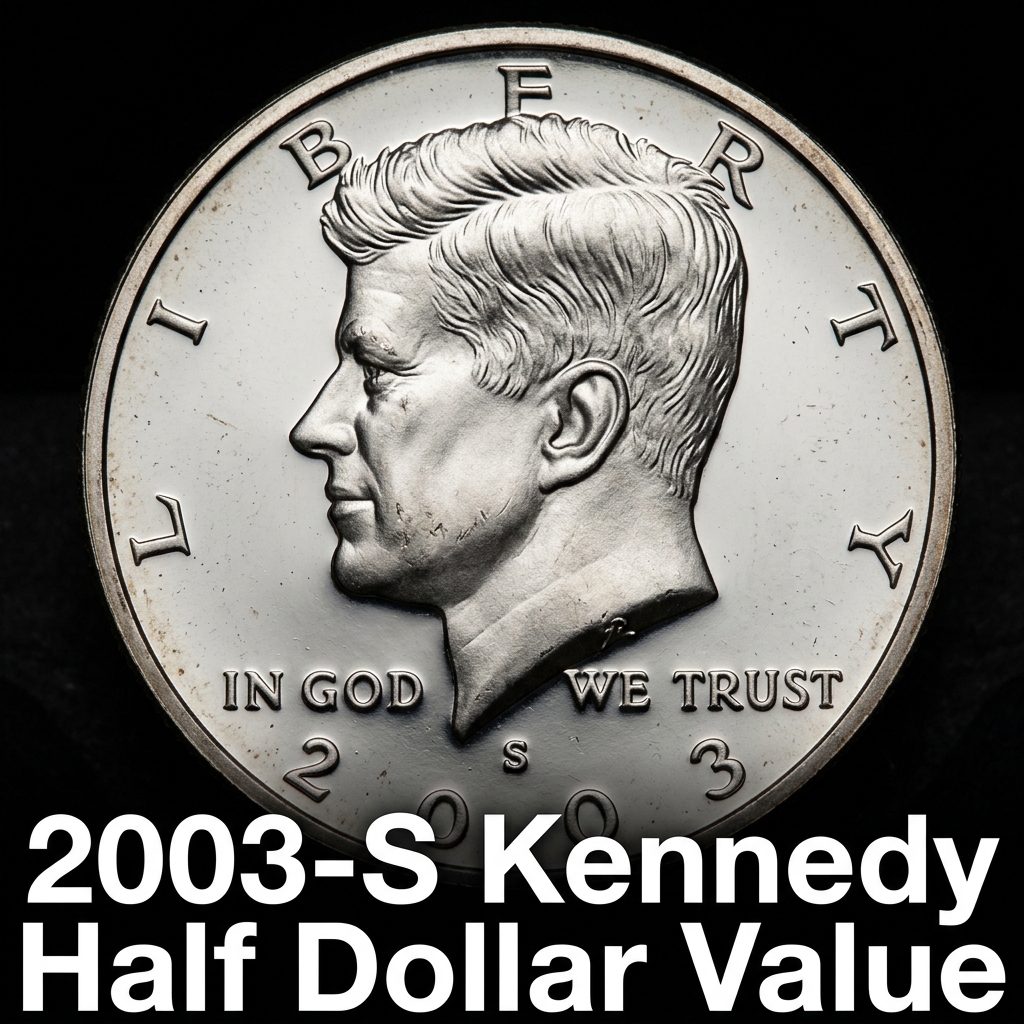
If you look at your 2003-S Kennedy Half Dollar under good lighting, you’ll notice two distinct surfaces: the raised portrait and eagle design appear frosty and white, while the flat background gleams like a mirror. This contrast is called the cameo effect, and coins with strong contrast earn a “Cameo” or “Deep Cameo” (DC) designation from grading services like PCGS or NGC.
Your Old Coin Could Be Valuable!
Identify It & Know Its Real Value — Free Download
Deep Cameo coins are the most sought-after, and they can sell for noticeably more than a regular proof of the same numeric grade.
When a coin is graded PR 69 DC or PR 70 DC by a professional grading service, it gives buyers confidence in both the grade and the eye appeal. That certification adds tangible value.
CoinKnow is a great tool for visualizing how cameo contrast affects value — the app shows you real photos of graded coins so you can compare your own piece side by side.
Your Old Coin Could Be Valuable!
Identify It & Know Its Real Value — Free Download
Should You Get Your 2003-S Kennedy Half Dollar Graded?
For most people, probably not — at least not right away. Professional grading through PCGS or NGC costs between $20 and $50 per coin at minimum, which can easily exceed the value of a typical 2003-S half dollar.
However, if you believe you have a PR 70 Deep Cameo example — meaning it’s absolutely perfect with zero visible flaws — then professional grading could be worth it. A certified PR 70 DC coin has a documented premium over raw (ungraded) examples.
If you’re unsure, use CoinKnow to get a quick preliminary assessment of your coin’s condition and likely grade range before spending money on third-party grading. It saves time and helps you make smarter decisions.
You can also explore a detailed breakdown of 2003 half dollar values including proof and mint state examples to understand the full spectrum of what these coins are selling for today.
Your Old Coin Could Be Valuable!
Identify It & Know Its Real Value — Free Download
Tips for Storing and Handling Your 2003-S Kennedy Half Dollar
Because the 2003-S is a proof coin, even small handling mistakes can reduce its grade and value. Always hold the coin by its edge — never touch the face or reverse with bare fingers. Oils from your skin cause hairlines and toning that are nearly impossible to reverse.
If your coin is still in its original U.S. Mint proof set packaging, keep it there. The original packaging provides both protection and provenance, which collectors appreciate.
Store your coins in a cool, dry place away from humidity and chemicals. Avoid cleaning them — even a light wipe can leave microscopic scratches that drop the grade significantly.
CoinKnow also has a coin storage and organization feature that helps you log your collection, track market values, and set alerts when prices shift — useful if you’re thinking about selling down the road.
Your Old Coin Could Be Valuable!
Identify It & Know Its Real Value — Free Download
FAQ
Q: How do I know if my 2003-S Kennedy Half Dollar is genuine?
A: Genuine 2003-S proof half dollars will have a sharp “S” mintmark on the obverse just above the date. They’ll also have the distinctive mirror-like fields of a proof strike. If you’re uncertain, use a coin identifier app or take it to a local coin dealer for a quick visual inspection.
Q: Is the 2003-S Kennedy Half Dollar made of silver?
A: No, the standard 2003-S Kennedy Half Dollar is composed of copper-nickel clad — the same metal composition used since 1971. However, if you have the 2003-S Silver Proof version (sold separately by the Mint), it contains 90% silver and carries a higher melt and collector value, typically ranging from $10 to $20 or more depending on silver spot price and grade.
Q: Where is the best place to sell a 2003-S Kennedy Half Dollar?
A: For common proof examples in original packaging, eBay and local coin shows are practical options. For high-grade certified coins (PR 69 DC or PR 70 DC), major auction platforms like Heritage Auctions or Stack’s Bowers can connect you with serious collectors willing to pay full market value.