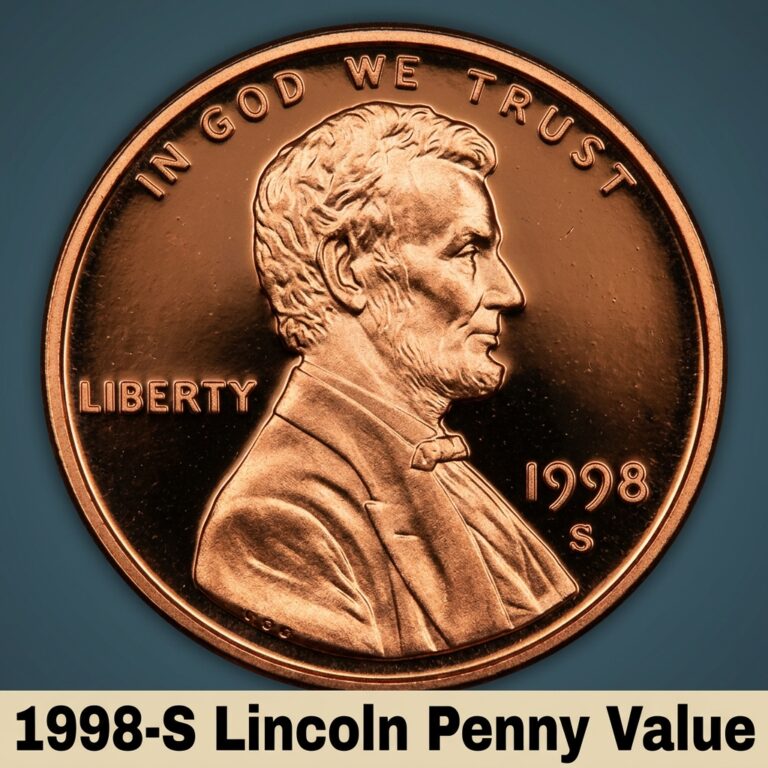
What is a 1981-S Type 1 Lincoln Penny Worth? Price Guide

Your Old Coin Could Be Valuable!
Identify It & Know Its Real Value — Free Download


The 1981-S Type 1 Lincoln Penny is worth anywhere from $3 in typical Proof condition to over $1,500 for rare, high-grade specimens. While these coins were never intended for your pocket change, finding one in an old collection can be a rewarding experience for any casual treasure hunter.
| Condition/Grade | Estimated Market Value |
|---|---|
| Proof 65 (Standard) | $3.00 – $5.00 |
| Proof 69 (Near Perfect) | $15.00 – $25.00 |
| Proof 70 (Perfect) | $500.00 – $1,500.00+ |
Understanding the 1981-S Type 1 Proof Penny
If you have stumbled upon a shiny, mirror-like penny dated 1981 with an “S” mint mark, you are looking at a Proof coin. Unlike the billions of pennies minted in Philadelphia or Denver for daily commerce, these were specially struck at the San Francisco Mint for collectors. Using a top coin identifier and value app is the best way to distinguish between common strikes and these specialty issues.
The term “Type 1” refers to the specific style of the “S” mint mark used during the first half of the year. In 1981, the United States Mint was in the process of replacing an old, worn-out mint mark punch. The Type 1 Mint Mark is often called the “Filled S” because the mint mark appears fuzzy, “blob-like,” and the loops of the “S” are almost filled in with metal.
For the everyday American, identifying this coin requires a close look at the mint mark under a magnifying glass. If you find the details hard to see, the CoinKnow app can help you zoom in and identify the strike type instantly. Understanding whether you have a Type 1 or the clearer Type 2 is the first step in determining the rarity of your find.
Your Old Coin Could Be Valuable!
Identify It & Know Its Real Value — Free Download
Difference Between 1981-S Type 1 and Type 2
The distinction between Type 1 and Type 2 is the most critical factor in 1981-S Lincoln Penny valuation. Collectors refer to the Type 1 as the “Filled S” and the Type 2 as the “Clear S.” By late 1981, the mint introduced the Type 2 punch, which created a much sharper, more defined “S” where the centers of the loops are hollow and clear.
Your Old Coin Could Be Valuable!
Identify It & Know Its Real Value — Free Download
In terms of scarcity, the Type 2 is generally considered more desirable and harder to find in perfect condition. However, the Type 1 still holds significant value, especially if it has achieved a high grade from a professional service. If you are curious about the current market trends, you can check the latest 1981-S penny price charts to see how these two versions compare in today’s economy.
| Feature | Type 1 (Filled S) | Type 2 (Clear S) |
|---|---|---|
| Mint Mark Appearance | Indistinct, “blobby,” centers filled | Sharp edges, clear centers |
| Relative Rarity | Common for the year | Less common |
The Importance of “Deep Cameo” Designations
When researching your 1981-S Type 1 Lincoln Penny Value, you will often see the abbreviation “DCAM” or “Deep Cameo.” This refers to the visual contrast of the coin. A Deep Cameo proof has a frosted, white appearance on Lincoln’s portrait and the Lincoln Memorial, while the background (the “field”) is as smooth and reflective as a black mirror.
Your Old Coin Could Be Valuable!
Identify It & Know Its Real Value — Free Download
Most 1981-S pennies were produced with this beautiful contrast. However, as the dies wore down during the minting process, the frosting became less intense. Coins that maintain that high-contrast “pop” are the ones that fetch the highest prices at auction. If your coin looks “flat” or lacks that frosty white look on the portrait, it might only be worth its “melt” or basic collector value of a few dollars.
Using CoinKnow can help you photograph your coin at the right angle to showcase this cameo effect. When you are looking for specific 1981 penny value information, remember that the DCAM designation is practically a requirement for any coin to sell for more than $10.
Your Old Coin Could Be Valuable!
Identify It & Know Its Real Value — Free Download
Grading and How It Affects Your Penny’s Value
Coin grading is done on a scale of 1 to 70. Since 1981-S pennies are Proofs, they usually start at a grade of PR60. A “perfect” coin is a PR70. The difference in price between a PR69 and a PR70 is staggering. A 1981-S Type 1 in PR69 might sell for $20, but the same coin in a PR70 holder can exceed $1,000 because perfect specimens are extremely rare.
Even a tiny, microscopic hairline scratch (often caused by cleaning the coin with a cloth) can drop the grade significantly. This is why you should never clean your coins! Even if your 1981 penny looks a little dull, cleaning it will strip away the original surface and ruin its numismatic value forever.
| Grade (PCGS/NGC) | Average Auction Price |
|---|---|
| PR67 Deep Cameo | $8.00 |
| PR68 Deep Cameo | $12.00 |
| PR69 Deep Cameo | $22.00 |
| PR70 Deep Cameo | $1,250.00 |
The Composition Shift: Why 1981 is Special
The year 1981 was a transitional period for the U.S. penny. Before 1982, pennies were made of 95% copper. After 1982, they switched to zinc with a thin copper plating. While the 1981-S Proof is made of the traditional copper composition, the rising price of copper at the time makes these coins feel heavier and more “substantial” than the pennies we use today.
Because these are 95% copper, they are susceptible to “spotting” or “toning.” If air or moisture gets into the coin case, the copper can turn orange, purple, or even green. While some collectors love “rainbow toning,” most Proof collectors prefer a bright, fiery red coin. High-quality CoinKnow users often track the “color” status of their coins, as “Red” (RD) coins are always the most valuable in the Lincoln Cent series.
Your Old Coin Could Be Valuable!
Identify It & Know Its Real Value — Free Download
Where to Sell Your 1981-S Lincoln Penny
If you’ve identified your coin as a 1981-S Type 1 and believe it’s in top-tier condition, you have several options for selling. For coins worth $5-$20, eBay or local coin shops are your best bet. However, if you believe you have a PR70 specimen, you should consider having it professionally graded by PCGS or NGC before sending it to a major auction house like Heritage Auctions.
Before selling, always check recent “Sold” listings rather than “Asking” prices. Anyone can ask for $10,000 for a penny, but that doesn’t mean it’s worth that amount. Look for actual completed transactions to get a realistic sense of what everyday Americans are paying for these San Francisco treasures.
FAQ
Q: How can I tell for sure if I have a Type 1 or Type 2?
A: Look at the “S” mint mark under 10x magnification. If the loops are filled with metal and look like a “blob,” it’s a Type 1. If the loops have clear, round holes in the center, it’s a Type 2.
Your Old Coin Could Be Valuable!
Identify It & Know Its Real Value — Free Download
Q: Can I find a 1981-S Penny in my pocket change?
A: It is very rare but possible! Sometimes people break open Proof Sets to spend them. If you find one in circulation, it will likely be scratched and “impaired,” meaning it will only be worth about $0.25 to $1.00.
Q: Is the 1981-S Penny made of gold?
A: No, it is made of 95% copper and 5% zinc/tin. Its shiny, gold-like appearance comes from the specialized “Proof” polishing process used by the Mint, but it contains no actual gold.
Q: Should I get my 1981-S Type 1 Penny graded?
A: Only if it appears absolutely perfect. Grading costs roughly $30-$50 per coin. Since most 1981-S Type 1 pennies are worth less than $20, it only makes financial sense to grade them if they have a chance at the rare PR70 grade.